
Case Study

Mobile Yard Ramps: range redesign under steel price shock

When steel prices more than doubled, the challenge was staying competitive against imports while keeping UK manufacture and compliance intact.

UK fabricator

Logistics

Margin protection

Example: Full range of yard ramps

Example: Full range of yard ramps

Situation

Between 2002 and 2005, steel prices more than doubled and showed no sign of easing. At the same time, low-cost imported alternatives began appearing in the market, increasing price pressure and steadily eroding margin on fabricated steel products.

For Thorworld’s mobile yard ramps (used to bridge height differences for forklift loading into containers and bays), this was an existential commercial problem: if the range couldn’t be re-engineered to a new cost base, it would become increasingly hard to justify UK manufacture while staying competitive.

The real problem

The brief wasn’t “make the ramp lighter” in isolation. The real problem was to reset the product specification and cost structure so the range could remain UK-built, price-competitive, and still meet the safety and performance expectations the market relied on.

That meant stepping back from incremental tweaks and treating the ramps as a product family: understanding what truly drove cost and weight, what could change without undermining function, and what had to stay fixed to preserve acceptance criteria and customer confidence.

Constraints

  • Competitive pricing pressure: material cost inflation and import competition demanded a step change in cost base, not marginal savings.
  • UK manufacturability: the range needed to remain buildable in-house with existing fabrication capability and realistic shop-floor processes.
  • Performance and safety: ramps had to preserve load capacity, stiffness/feel, and operational robustness in real loading environments.
  • Standard-led acceptance: designs had to be substantiated to EN 1398 and steelwork checked to BS 5950, supported by type testing.
  • Range continuity: changes had to be compatible with existing product positioning (types 6/7) while enabling new variants (types

Client:

Thorworld Industries

Role:

Lead Design Engineer

Period:

2005–2009

Scope:

Range re-spec + re-design + new variants

Acceptance Basis:

EN 1398 / BS 5950; substantiated + type tested

Key moves

Resetting the spec with stakeholders

  • Researched the market context and competitor landscape to clarify what “competitive” meant in practice (price points, expectations, perceived quality).
  • Converted that into an updated product specification for internal review — surfacing non-negotiables and areas where the legacy spec was over-constraining cost.

Baseline modelling and identifying cost/weight drivers

  • Built baseline models of the existing ramps and assessed how the current architecture performed.
  • Identified the dominant weight and cost drivers (where steel was being “spent” for limited performance return) and created a ranked improvement opportunity list.

Developing costed concepts in CAD

  • Developed multiple alternative concepts and refinements in 3D CAD, not just one “redesign”.
  • Produced fully costed options so selection could be made on total outcome (manufacture time + material + - sk), not aesthetics or intuition.

Verification (CAE + hand calcs to BS)

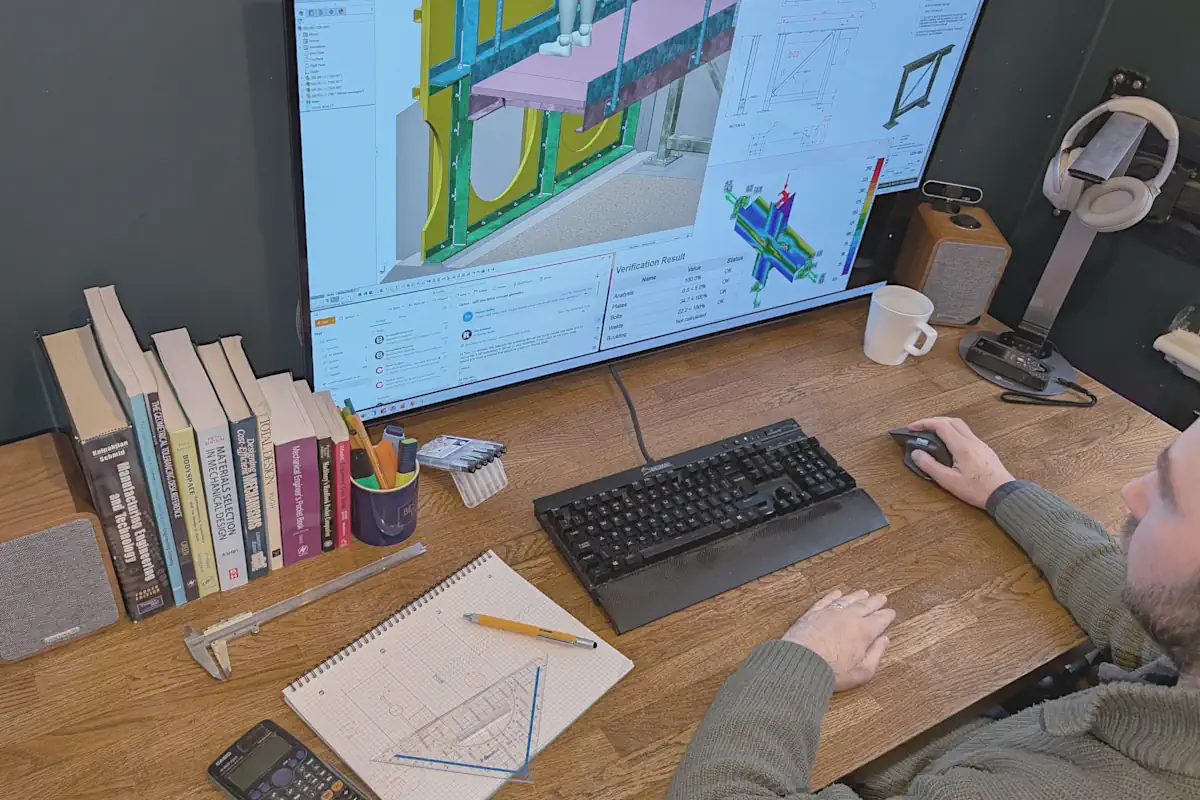
  • Tested concepts using CAE to compare load paths, stiffness, stress hotspots, and sensitivity to assumptions.
  • Backed this up with hand calculations to BS 5950 to keep the engineering traceable and acceptance-focused - ther than “software says it’s fine”.

DFMA with buyers / shop floor

  • Worked closely with buyers, welders, and machine operators to ensure ideas translated into buildable reality.
  • Iterated details to reduce fabrication hours and variability (part rationalisation, joint detailing, - lerances, weld access, handling/fixturing considerations).

Type testing + CE technical file

  • Planned and oversaw physical type testing on prototypes to validate both performance and any remaining modelling assumptions.
  • Collated technical documentation into a structured file to support CE marking requirements for the product range.

Selected Snapshots

Example: Full range of yard ramps

Each part of the sculpture was designed to be palletised and fit-checked for safe transport by shipping container from the Middle East to the US.

Example: Full range of yard ramps

Caption text 2

Example: Full range of yard ramps

Caption text 3

Outcome

The programme first optimised the existing high-volume ramps (types 6 and 7), then delivered entirely new designs (types 8, 9 and 10) between 2007 and 2009. Across the refreshed range, weight — and therefore steel cost — was materially reduced, while maintaining the functional feel and acceptance basis the product category depends on.

Practically, this enabled Thorworld to offer a broader set of ramp variants and capacities, reduce selling prices while restoring margin to sustainable levels, and increase throughput by making the ramps faster and more consistent to manufacture.

The real problem

This work wasn’t just “a lighter ramp”. It reset the viability of a flagship product family during a period when many fabricated-product businesses were being squeezed hard by material inflation and aggressive imports.

By re-establishing a competitive cost base while preserving standards-led acceptance and real-world robustness, the ramp range remained commercially defensible through the subsequent downturn — and created a platform for continued product-line expansion rather than retreat.

Client Feedback

The MD noted that the project delivered outsized value for a junior engineering resource: significant reductions in steel content and build effort that reset the cost base and kept the range profitable to manufacture in the UK despite cheaper imports. The structured approach—spec reset, costed options, DFMA iteration, and standards-led substantiation with type testing—helped the business implement changes with confidence.

Contact

If you need to solve a problem and you’d like to explore whether I can help, drop me an email:

What to include

To help me give you a useful reply, please mention…

  • What you’re building or dealing with (one or two sentences)
  • What’s going wrong, or what decision you’re trying to make
  • Key constraints (budget, timescale, materials, interfaces, standards)
  • What information you already have (CAD, drawings, photos, etc)
  • Desired outcome (e.g. options report, CAD pack, calcs, FEA etc)
  • Any deadlines and why they exist (so I can reality-check them)

Attachments

Attachments are welcome:

  • All enquiries and attachments are treated as confidential by default
  • If attachments are over 2MB, please use a file-sharing service such as Dropbox or WeTransfer and include a download link.

What happens next?

I’ll usually reply with a quick fit-check…

If it's a fit:

  • I’ll tell you whether and how I can help
  • I’ll give you some options for how we could move forward
  • I’ll ask for the minimum info needed to scope it

If it's not a fit:

  • I’ll say so and tell you why
  • I may suggest an alternative route, if appropriate

Email me directly at:

hello@frugaldesign.co.uk
Compose email